> For the complete documentation index, see [llms.txt](https://beafn28.gitbook.io/beafn28/llms.txt). Markdown versions of documentation pages are available by appending `.md` to page URLs; this page is available as [Markdown](https://beafn28.gitbook.io/beafn28/writeups/dockerlabs/balufood.md).
# BaluFood
✍️ Autor: El Pingüino de Mario🔍 Dificultad: Fácil 📅 Fecha de creación: 29/04/2025
### 🔍 RECONOCIMIENTO
En primer lugar, tras conectarnos a la máquina, utilizamos el comando:
```bash
ping -c 1 172.17.0.2
```
para verificar la conectividad de red.
A continuación, realizamos el comando:
```bash
nmap -sVC -p- -n --min-rate 5000 172.17.0.2
```
para realizar un escaneo de puertos y servicios detallado en la dirección IP.
Como podemos observar durante el escaneo, el **puerto 22** correspondiente al servicio **SSH** y el **puerto 5000**, comúnmente utilizado por **aplicaciones web en desarrollo**, se encuentran abiertos, por lo que a continuación se indagará más sobre ambos servicios, intentando establecer una conexión remota vía SSH y acceder mediante el navegador al servicio web en el puerto 5000 para identificar posibles vectores de ataque.
### 🔎 **EXPLORACIÓN**
Se utiliza el comando:
```bash
sudo nmap -sCV -p22,5000 -v 172.17.0.2
```
para obtener más información sobre esos puertos específicamente.
Revisamos el puerto 5000.
### 🚀 **EXPLOTACIÓN**
Es una página web de un restaurante e indagando un poco vemos que tenemos un panel de login y además nos podemos loguear con credenciales por defecto (admin:admin).
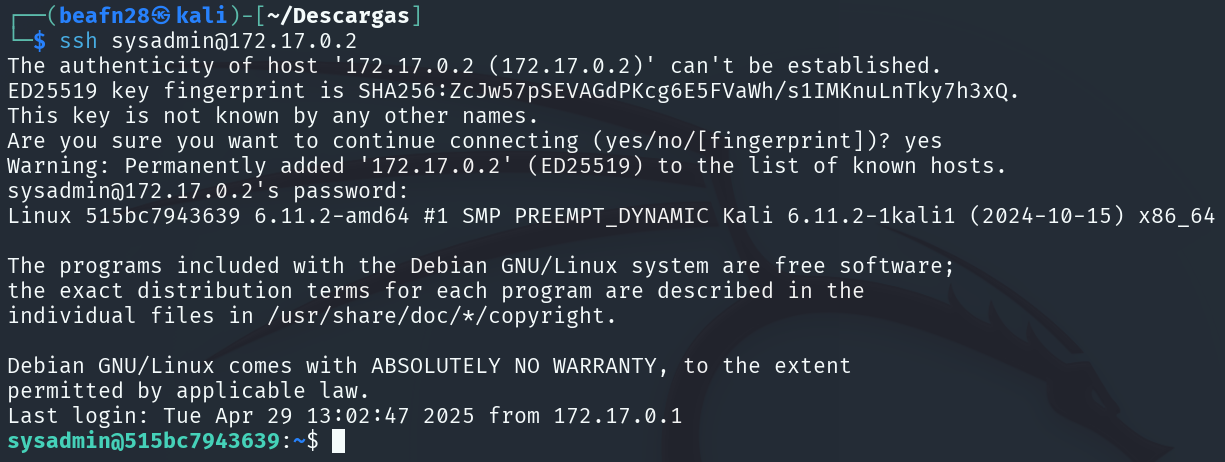
Viendo el código fuente nos encontramos unas credenciales por lo que nos conectamos por **SSH**.
```bash
ssh sysadmin@172.17.0.2
```
### 🔐 **PRIVILEGIOS**
Al estar dentro y ejecutar:
```bash
whoami
```
aún no somos **root**, por lo que hacemos:
```bash
sudo -l
```
No tenemos permisos sudo pero en su directorio principal si listamos y mostramos el contenido del archivo **app.py** vemos una contraseña.
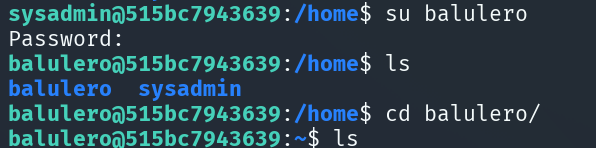
Nos cambiamos al otro usuario con esa contraseña encontrada.
```bash
su balulero
```
Revisando el historial nos encontramos que ha cambiado un fichero por lo que revisamos.
Hemos encontrado al parecer la contraseña de root por lo que nos logueamos.
```bash
su root
```